

Diamonds and Dining Rooms

One could perhaps attribute the decision to the January-induced courage every new year bestows, or to the fact that the months I now spend east of the Atlantic have rubbed off on me like the dye of a cheap shawl. Whatever the reason, this was a decision most spontaneous indeed. The very fact that it only took me perhaps an hour, at most, to go from idea to execution — a process afforded an infinitely quicker follow through than my other ideas, who always, poor things, linger too long in the contemplation stage — has left me thinking.
I come from a family where natural stones are the greatest gift one could give or receive. Hands, male or female, are adorned with aqeeq, yaqut, dur-e-najaf. Perhaps the affinity sounds superficial or silly, but for those familiar with the concept, they’ll know this is a custom following a long tradition once held by great saints, including the blessed Prophet ﷺ. Because my hands are full now, I seldom think of buying new stones. But when I came across an article on the benefits of wearing one’s birthstone, I realized that I didn’t wear mine. I considered another ear piercing so I’d always have one on me, but have never quite liked the look of a cluttered ear. When I voiced this to my sister, she offered a simple solution: I should get a nose piercing. I looked at her with her dainty gold hoop, and then at my mother seated beside her, who I have only ever known with a big diamond flower smack dab in the middle of her face.
One unbelievably long needle later, I too had a diamond flower adorning my nose.
In the subcontinent, it’s far from uncommon for a woman to have a nose piercing. My mother, grandmother, sister, aunt, friends, etc., have all worn a stud or ring, and so by comparison I was quite late to the party. It is, though, in many ways a symbol of womanhood. The decision to get it when I did, then, could not have come at a more apt time in my life. I had found myself on a hamster wheel of epiphanies over the last few months, particularly in the weeks leading up to the piercing. The reality of muliebrity, and existing as a young woman in male-dominated spaces, had dawned upon me with particular force. Words fail me now as they did then; it is an experience that defeats language at the moment it matters most — tightening the throat, stilling the pen, and leaving only the crushing weight of the thing itself.
I write this, too, just having spent the last few months in Islamabad, where such epiphanies come with countless (and merciless) added layers. Only but a moment in the hilly city’s main supermarket is needed to offer one the full picture of its diversity. The image of woman will vary from those clad in Western dresses with fresh blowouts to the (very) occasional blue burqa. It’s nothing worthy of widened eyes, but something that makes me consider how no matter what, here and everywhere, a woman is a woman before all else. She is recognized and judged as such, whether covered or not, makeup-wearing or not, wrinkled or botoxed. You are seen before you are heard — veiled or unveiled — looked at before you are listened to. Every tiny thing about you is examined and poured into an assumption, including something as seemingly meaningless and minuscule as a piece of jewelry. It is a reality every bit as exhausting as it is absurd, and yet, it is a truth as old as time itself. A grief, too, that defies expression.
Accordingly, Islamabad’s daily gift to me was a catalogue of sighs and swallowed complaints. Alas, though, this is the universal inheritance for women, and always has been, from times and tribes beyond my imagination. This remembrance compelled me to recall the living room of my family home in Islamabad. Childhood memories are scattered with scenes of playing within its warm boundaries, the paintings that adorned its walls etched in the archives of my joy. One such was the portrait of a woman from nearly a century ago, who, like me, also wore a large nose ring, and also had her fair share of complaints. The woman in question was my great grandmother Mehrbano, my nana’s mother. An Iranian woman living in pre-partition India, she was renowned for her beauty and grace, as well as for the jewelry of ‘sixteen brides’ that made music as she walked. I have known her only through such passed down stories and that living room portrait, but recent circumstances have afforded her memory a comfortable seat in the foyer of my mind.
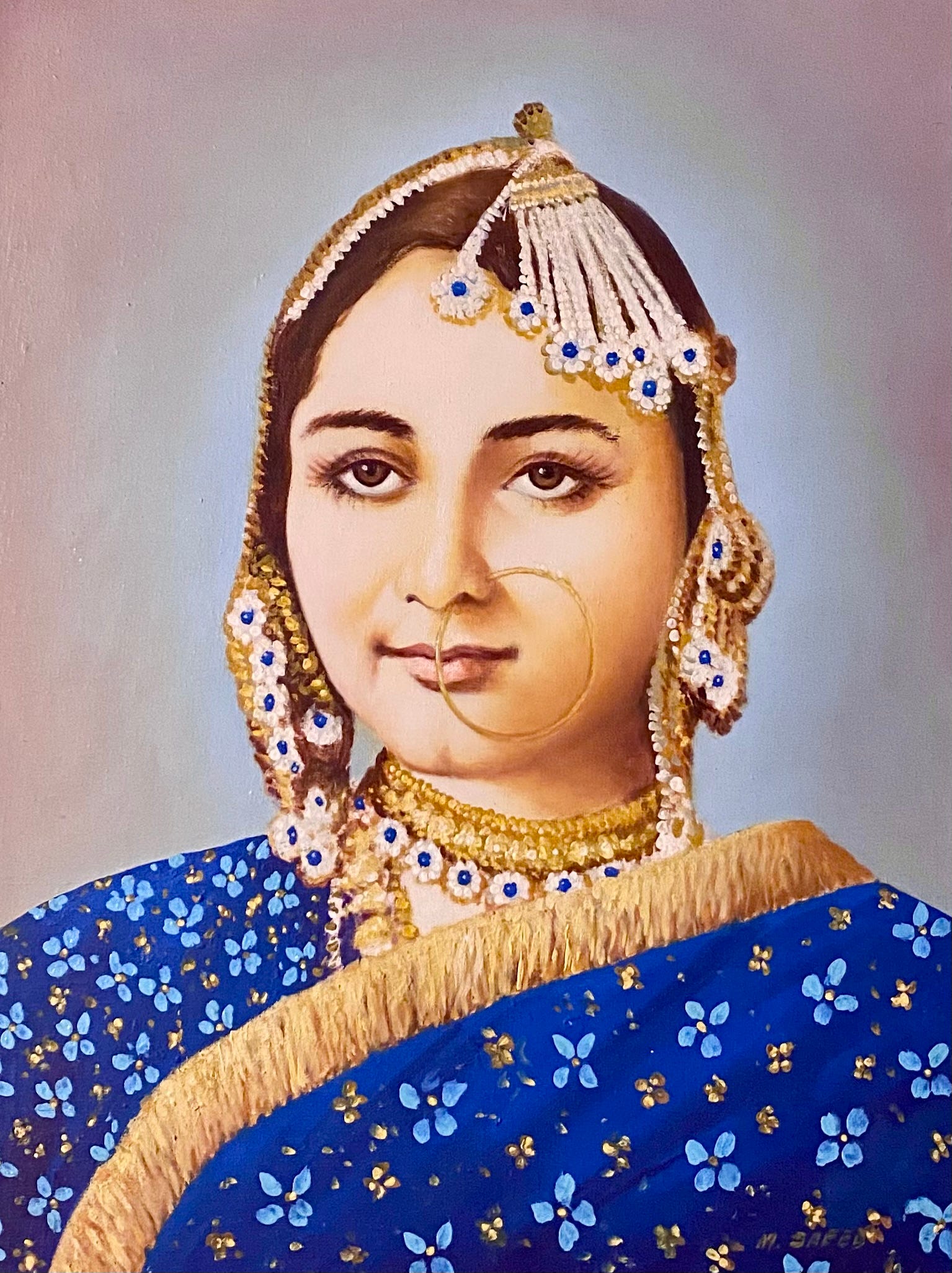
She would have been dismissed, by any casual observer, as perhaps a woman of surfaces. But she was also a woman who, despite her apparent privilege and fortune, experienced great trial and tribulation. When she decided to divorce her husband, her father and brothers disowned her. For any woman to do so at the time was already taboo — for a woman of such status to do so was unthinkable. With three young children, nonetheless, and despite the pressures of the era and its norms, she persisted, refusing to give up when it would have been easier to do so. God, ever so Merciful, rewarded her patience with victory. She went on to remarry my great grandfather, have five more children, and live a life that defied the smallness of the world she was born into.
She was eclectic and fierce, just as steadfast as she was spirited. But she was also someone who, based on appearance alone, would have been reduced to nothing beyond label or looks. I know, though, that she married my great grandfather for love, and he was a man so thoroughly intriguing, so devoted to his intellectual pursuits and passions, that I know something in her had to have mirrored that fire. Their home hosted dinner parties decorated with intellectuals and poets, where discussions of Pakistan’s eventual creation blossomed. I know as well as any woman how often we are minimized in recollections of history and its great happenings, and so I imagine that dining room in Delhi and wonder about Mehrbano’s place in it. What she’d say — because she wasn’t one to shy away from sharing — which ideas she helped cultivate, which beliefs she too held with conviction. How desperately I wish I could know, travel in time and catch a glimpse. But in this desire lies another sorrow, for her death before partition meant she would be put to rest across the border. With India’s visa prejudice, I wonder if I’ll ever be able to visit her grave, or roam the streets she once did.
Regardless, as the hamster wheel continues to spin, I’ve been thinking of her devotion to getting what was rightfully hers, of her commitment to having her voice heard. Women have, in every time and place, exhibited a kind of strength that is forged differently from that of men — not because men lack it, but because they are not subjected to the particular ordeals that make our sacrifices so costly, our commitments so quietly heroic. But woman is the first teacher after all — it is she who educates a child, and in that contributes to the shaping of society in the most fundamental of ways. What she speaks up for, what she endures, what she refuses to accept — these decisions form the architecture of the world. Carrying the weight of this knowledge, as every woman does, makes strength not only a virtue, then, but an obligation. It is not easy, of course, but creation never is. How shameful, then, that such truths are buried beneath language that has a vocabulary only for what one wears.
Although I never could meet her, I suppose in some ways I know her still. I’m always told I carry my mother’s face, who looks like her father, who looked like his mother Mehrbano. I’d like to hope that beyond some physical resemblance, a nose piercing, and our shared faith*, I perhaps inherited a sliver of her courage. So when I grow weary of this world and its trials for women, I remember her and all those before and beside me. I’ll resist the urge then, amidst small minds and wandering eyes, to dwell in despair over the gazes of the earthbound. I’ll find solace in a greater fact, because diamonds bring clarity to the wearer, after all. What grief is to be held when the sky needs lifting? The remembrance of Al Basir, the only One who truly sees, is enough to set one free — and Who could be sweeter company?
Cover photo is ‘The Patient Vigil’ by Pakistani artist Abdur Rahman Chughtai.
*Though she was Shi’i, which I feel was a defining element of her identity and spirit, out of her eight children and dozens of grandchildren + great grandchildren, interestingly enough, only my mother, siblings, and I share that label.
لوگ عورت کو فقط جسم سمجھ لیتے ہیں
روح بھی ہوتی ہے اس میں یہ کہاں سوچتے ہیں
روح کیا ہوتی ہے اس سے انہیں مطلب ہی نہیں
وہ تو بس تن کے تقاضوں کا کہا مانتے ہیں
روح مر جاتی ہے تو جسم ہے چلتی ہوئی لاش
اس حقیقت کو سمجھتے ہیں نہ پہچانتے ہیں
کتنی صدیوں سے یہ وحشت کا چلن جاری ہے
کتنی صدیوں سے ہے قائم یہ گناہوں کا رواج
لوگ عورت کی ہر اک چیخ کو نغمہ سمجھے
وہ قبیلوں کا زمانہ ہو کہ شہروں کا رواج
جبر سے نسل بڑھے ظلم سے تن میل کریں
یہ عمل ہم میں ہے بے علم پرندوں میں نہیں
ہم جو انسانوں کی تہذیب لیے پھرتے ہیں
ہم سا وحشی کوئی جنگل کے درندوں میں نہیں
(Sahir Ludihanvi)
My dearest Zahra Jan, Thank you so much for honoring your great grandmother and my Daadi Jan. She must have been smiling in heaven, sending endless blessings for her courageous great granddaughter. Indeed you have inherited her spirituality, courage and tawakkul too. May you always be the shining bright Zahra, not only for her, but for the world!