

Every Lament is but a Love Letter
On loving, and losing, the Holy Household

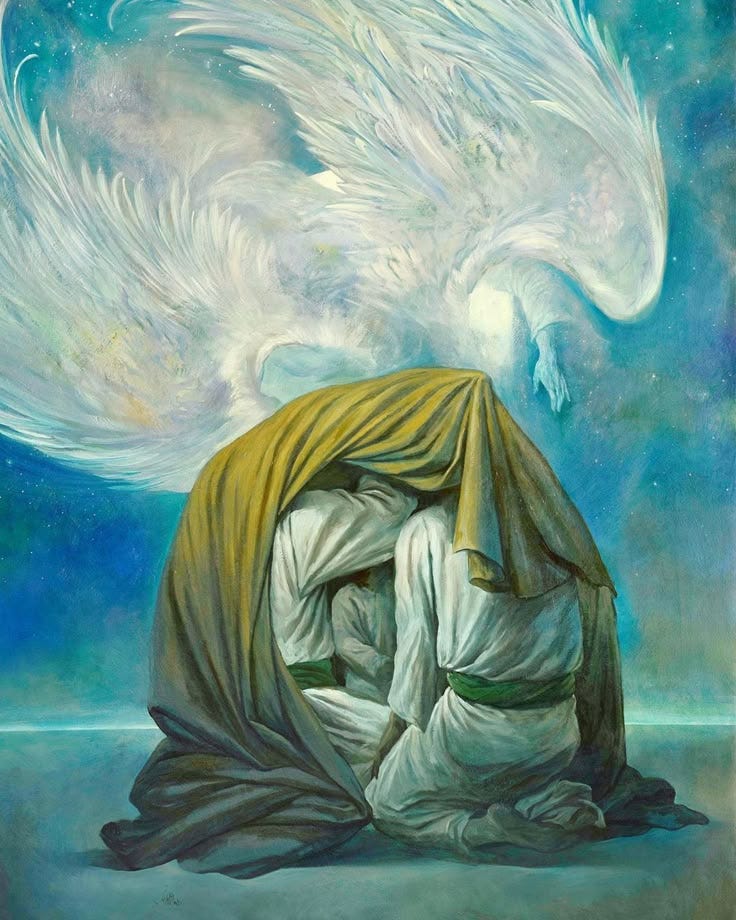
The sweetest moments of my life are those that flowed from continuity; every year, no matter where or what season, for ten days, we belonged to Husayn. We wore only black, sang no song, and spent our evenings within the sacred walls of the masjid. We sat with no space to move, poetry echoing, tears falling, history remembering.
In Karachi this very week, as men, women, and children came together for this holy tradition in the comfort of their imambargah, a speeding car rammed itself through the tents where they sat for majlis al-Husayn, injuring multiple people. People who sat for one cause and one cause only: to love and honor the memory of the Prophet and his family — were deemed, for that reason alone, undeserving of life.
This story is nothing new in Pakistan. This story is nothing new for the lovers, and knowers, of the holy Household. Anywhere in the world the memory of truth is recounted, hearts consumed by falsehood will come to set aflame what they cannot know. To love Hussain is to know Yazid lives today — even in the hearts of those who claim that they too, are Muslim. To love Ali, Fatima, and Hasan too, with honesty and courage, is to know this grief deep in your being.
As my years added on and these assaults continued — as our processions became a death wish, our names a target, our faith a threat — my laments grew stronger. I searched desperately for a way to reconcile this brokenness; to mend what time, apparently, could not. I nearly drowned myself in sorrow, drove myself mad out of grief over history’s treacherous repetition. Why! I beseeched God. How! I wailed. I searched through every avenue I could for an explanation, I tried and I tried and then tried more. I thought myself to so many small deaths. And I did this out of love and only love, for this is the only love I have ever known. I remembered Hadith e Kisa;
Allah the Almighty said:
‘O My Angels and the inhabitants of My heavens, know that indeed, I have not created the raised sky, the stretched earth, the bright moon, the illuminating sun, the revolving planets, the flowing river or the sailing ship except for the love of these five people who are under the cloak.’
The trustworthy archangel Jibra’il asked:
‘O my Lord, who are [these individuals] under the cloak?’
Allah, the Almighty, said:
‘They are the household of the Prophet and the wellspring of Prophethood; they are Fatimah, her father, her husband and her sons.’
And so my sorrow knew no bounds — our world was defined not by the love of this family; but by the loss of it. I wept for an imagined world; an honest one. One that loved Hussain enough to ask why he had to suffer at all, one that questioned why Hasan was poisoned, one that honored Fatima enough to remember her stature, one that knew Ali the way he deserved. One that, above all, loved Muhammadﷺ enough to listen to his call; ‘Hold my family close.’
In this imagined world, loving them would be no crime, their memory would be no threat, and these truths would not be dismissed and insulted. But the greatest grief is that in such a world of honesty, the children of Gaza, Jnoub, Sanaa, Minab, Parachinar, Khartoum, and beyond, would know life. They would not have had to pay for this loss with their blood. I wept at the scenes of bloodied worshippers and forgotten martyrs — at the loneliness of today’s Husseinis, who stand before an empire all alone, once again.
Alas, many days and nights passed me by on this journey that seemed never to end; across shaded seas and torrential rains, I sailed a sinking ship. Amidst the roaring waters and trembling skies, I sought out a great hope: the island of explanation.
With each strike of the wind I looked outward and hoped the shore and I would meet at last, only for my eyes to meet the same sight, navy touching navy. The anguish and fatigue of this failing journey sunk into my every breath and every step. Yet, I remained upon my creaking boat, less a ship than a canoe, with this force left to sit upon me, heavy enough to unravel one’s very spirit; a mountain atop every atom within me, aching my throat and watering my eyes. I watched from the distance the same storms that compelled my woe, hoping my journey would come to an end soon, and with it my silence.
So I let more nights pass me by in my ever lonely run through the sea, until, at last, the flutter of tiny wings lifted me to liberation. In their flight, I learned that such an island need not be sailed to at all, for the waters shall never cease to be.
The weight could never crush me, I now knew, because I did not understand what I thought I was grieving. God is most merciful indeed. Every lament is but a love letter, after all.
There is no power other than God, the Just, the Most High, praise be to Him. May His blessings be eternally upon Muhammad and the family of Muhammad.
You may enjoy:


“Every lament is but a love letter.” What an incredibly powerful piece. 🥺
سبحان الله
What a beautiful piece.
This year was the first year of my life that I mourned for the Family of our dear Prophet صَلَّى ٱللّٰهُ عَلَيْهِ وَآلِهِ وَسَلَّمَ.
The ten days of mourning for Aba Abdillah (as) softened my heart more than the entirety of my life’s prayers and worship. As lovers of AhlulBayt (as), our life in this dunya will always be made difficult, but as someone who has lived on the other side, my life has never been better. Sacrifice exists on both sides because this world is cruel regardless, but the sacrifices we make have value and meaning attached to them. Our sacrifice is rewarded in the form of peace for our souls. We fight our nafs and mourn for Sayyida Fatimah (SA) and watch the way it brings tranquility in our hearts. Allah has blessed us, the Husseinis, “there is a favour upon us which the enemy cannot touch”.